
EBOO Blood Filtration

Understanding the First Stage of Extracorporeal Blood Treatment
Blood transports oxygen, nutrients, hormones, and essential molecules throughout the body. It also carries metabolic waste products and other substances that must be processed or eliminated through the body’s natural filtration and detoxification systems.
At Synaptic Sports & Longevity, our EBOO system incorporates an extracorporeal blood circuit, a specialized filtration membrane, and a separate oxygen-ozone treatment component.
EBOO stands for Extracorporeal Blood Oxygenation and Ozonation. During the procedure, blood circulates outside the body through a controlled medical circuit before returning to the patient. The filtration component is one of the distinctive features of this system.
Table of Contents
What Is Blood Filtration?
Blood filtration uses a specialized membrane to separate or retain certain substances based on their physical and chemical properties. The membrane contains microscopic pores and provides a large surface area through which substances may move under appropriate conditions.
Unlike an ordinary household filter, a medical blood-filtration membrane interacts with a complex mixture of blood cells, proteins, dissolved molecules, and fluids. Its performance depends on pore size, membrane material, blood flow, pressure, and circuit design.
How Does the Filtration Membrane Work?
The EBOO filtration cartridge used at Synaptic is understood to incorporate a cellulose triacetate (CTA) membrane, a material also used in certain medical blood-filtration devices. This specification should be confirmed with the manufacturer before publication.
Cellulose triacetate is a modified cellulose material designed for contact with blood. Three mechanisms are important:
1. Size-Based Filtration
The membrane acts as a selective barrier. Depending on pore size and operating conditions, water and certain dissolved molecules may cross the membrane, while larger components are prevented from passing through. Red blood cells, white blood cells, platelets, and many larger blood proteins are generally retained within the blood compartment of an intact membrane.
2. Membrane Retention
Some substances are too large to pass through the membrane’s pores. They may remain on the blood side of the membrane and, under certain circumstances, accumulate on its surface or within accessible pore openings.
A substance that cannot pass through the membrane is not necessarily removed from the patient’s circulation. Effective removal requires that it become trapped, adsorbed, or transferred into a separate collected fluid rather than simply continuing through the blood circuit.
3. Adsorption
Certain proteins and other molecules may adhere to the membrane surface through adsorption, which is different from passing through a pore. The amount and type of material adsorbed depend on the membrane’s surface characteristics and treatment conditions. Research on cellulose triacetate membranes has demonstrated adsorption of plasma proteins, but adsorption does not necessarily mean selective removal of harmful substances; normal and beneficial proteins may also interact with the membrane.
What Substances May Be Affected by Filtration?
| Blood component | Expected membrane interaction |
|---|---|
| Red and white blood cells; platelets | Generally remain in the blood circuit rather than passing through an intact membrane |
| Large proteins, including albumin and immunoglobulins | Often substantially retained by pore size; some may adsorb |
| Fibrinogen and other clotting proteins | May interact with or adsorb to the membrane surface |
| Certain inflammatory proteins | Potential membrane interaction, depending on molecular characteristics |
| Small metabolic waste molecules | May cross suitable membranes if an appropriate removal pathway exists |
| Water and electrolytes | Movement depends on permeability, pressure, and circuit design |
Why Is a Blood Thinner Used During EBOO?
When blood circulates outside the body, contact with artificial tubing and filtration surfaces can activate clotting. Clots can obstruct the cartridge and interfere with blood flow, creating potentially serious complications.
An anticoagulant such as heparin is administered according to protocol to reduce clotting in the extracorporeal circuit. Anticoagulation does not eliminate clotting risk and introduces bleeding risk. The medical team must evaluate medications, bleeding history, platelet abnormalities, and other relevant conditions.
Who Should Not Undergo EBOO?
Because EBOO involves vascular access, extracorporeal circulation, anticoagulation, and ozone exposure, careful patient selection is essential. Conditions that may make it inappropriate or require specialist evaluation include:
- Active bleeding or significant bleeding risk, especially when anticoagulation is required
- History of heparin-induced thrombocytopenia (HIT) or serious heparin allergy
- Severe anemia or significant blood disorders
- Hemodynamic instability, severe hypotension, or unstable cardiovascular disease
- Serious active infection or bloodstream infection requiring medical management
- Pregnancy, because adequate safety evidence is lacking
- G6PD deficiency, due to concerns about oxidative injury and hemolysis with ozone exposure
Additional precautions may apply to patients taking anticoagulant or antiplatelet medications, those with kidney or liver dysfunction, and those with a history of reactions to extracorporeal procedures. All patients are thoroughly screened and blood work is checked prior to the procedure.
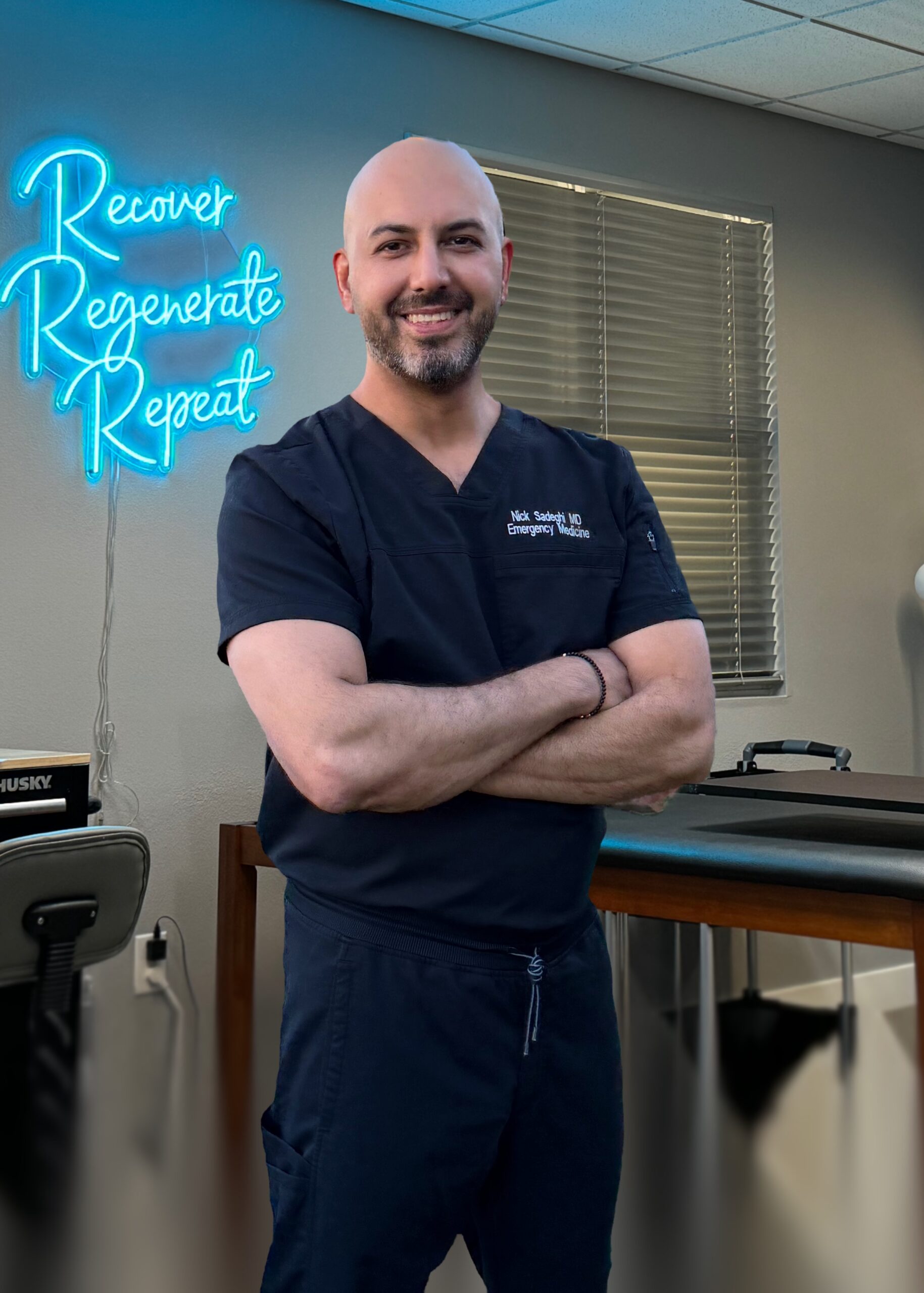
Meet Dr. Nick Sadeghi
“The mission of Synaptic is to help people stay strong, active, healthy, and engaged throughout every stage of life by combining longevity medicine, regenerative therapies, recovery science, and athlete-focused care into one integrated system.”
Whether the goal is optimizing athletic performance, improving recovery, restoring energy, or supporting healthy aging, Synaptic focuses on helping the body function at a higher level for longer. Using modern therapies such as Hormone Replacement Therapy, NAD optimization, Regenerative medicine, Chiropractic body work, PRP, Tenex, EBOO, and advanced recovery modalities, Synaptic is designed to support performance, resilience, recovery, and long-term vitality.
Dr. Nick Sadeghi
The Synaptic Way: Filtration, Ozonation, and Complementary Recovery Technologies
At Synaptic, synergy is central to our approach. EBOO itself combines two different processes: blood filtration, involving interaction with a specialized membrane, and oxygen-ozone exposure, intended to influence biological processes through controlled oxidative reactions.
Our broader approach also considers complementary modalities, such as Hyperbaric Oxygen Therapy (HBOT). HBOT delivers oxygen under increased atmospheric pressure and has established applications for specific medical conditions. Researchers also study its effects on tissue oxygenation, wound healing, and cellular responses.
EBOO and HBOT are fundamentally different treatments. At Synaptic, we evaluate each individually and consider potential complementary roles within a personalized plan. The Synaptic Way is about understanding how different medical technologies interact—not simply adding more treatments but selecting approaches that make sense together.
Explore EBOO at Synaptic
EBOO brings together extracorporeal blood circulation, membrane filtration, and oxygen-ozone treatment in a single procedure. At Synaptic Sports & Longevity, we believe patients should understand both the science and the limits of available evidence.
Learn more about EBOO, its filtration and ozonation components, and how our team evaluates treatment options as part of individualized health and recovery care.